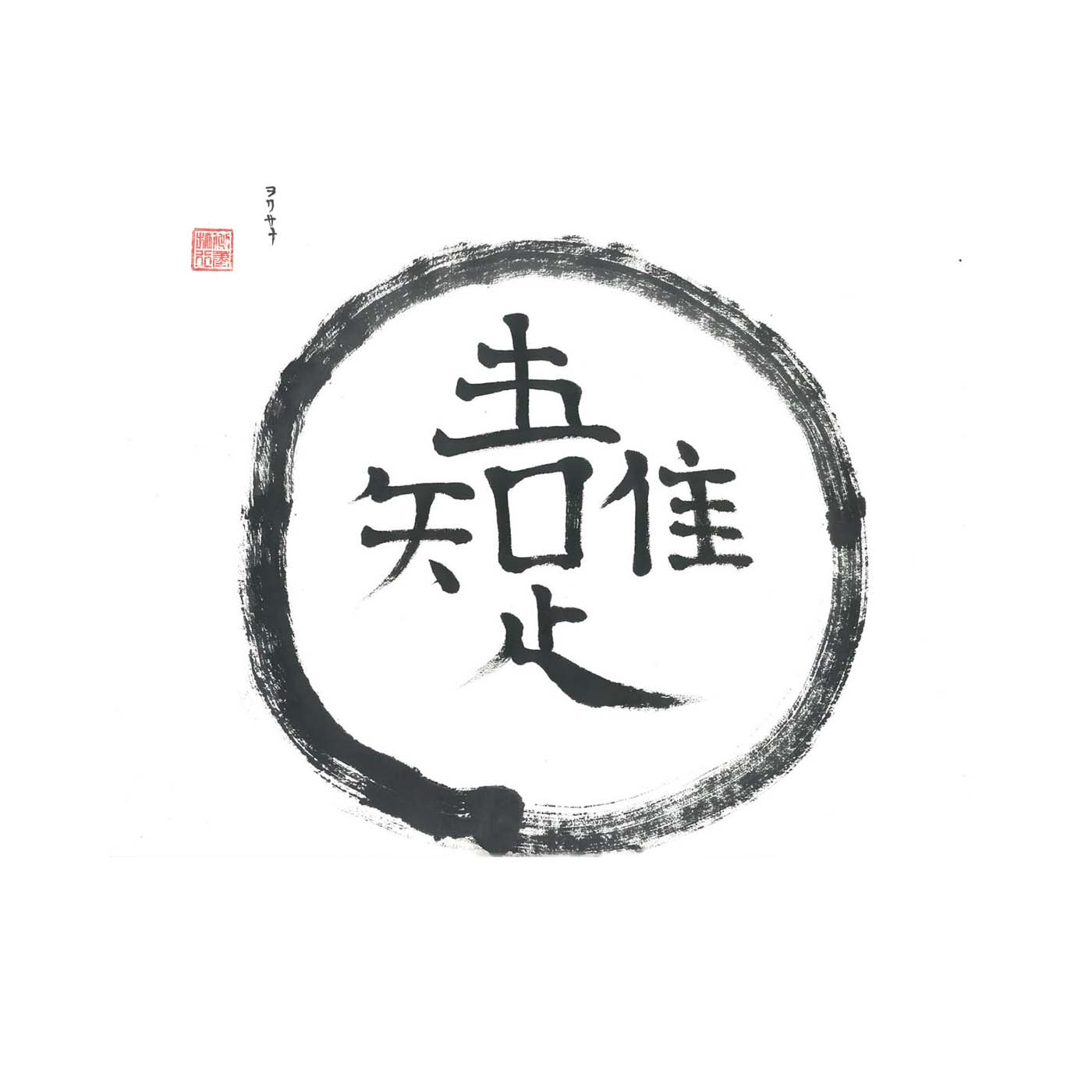
If there are mountains, I look at the mountains; On rainy days I listen to the rain. Santōka Taneda
One has all one needs
Characters and Phrases (黒音 - Black Sound)
The phrase "one has all one needs" is a common English interpretation or translation of a Japanese phrase, "吾唯足知" (or in modern characters, 吾唯具足知), which is a Zen teaching found on the famous tsukubai (stone water basin) at the Ryōan-ji Temple in Kyoto. The specific tsukubai at Ryōan-ji was donated in the 17th century by the feudal lord Tokugawa Mitsukuni.
The four characters, when read alone (go, tada, taru, shiru), have no meaning. However, when each is read in combination with the square opening in the center of the basin (which represents the character 口, kuchi, meaning "mouth" or "opening"), they form four new characters and a meaningful phrase.
It can also be translated as "I only know contentment" or "One already has all one needs." The wandering Zen monk Santōka Taneda (1882–1940) captured this "enough-ness" in this minimalist haiku: